Toll (FGCT) Pty Ltd v Alphapharm Pty Ltd
Toll (FGCT) Pty Ltd v Alphapharm Pty Ltd
[2004] HCA 52 (11 November 2004)
(High Court of Australia)

Case details
Court
High Court of Australia
Case S63/2004
Citations
Toll (FGCT Pty Ltd v Alphapharm Pty Ltd
[2005] HCA 52 ➤
(2004) 219 CLR 165
(2004) 79 ALJR 129
(2004) 211 ALR 342
(2005) Aust Contract R 90-204
Judges
Gleeson CJ
Gummow J
Hayne J
Callinan J
Heydon J
Appeal from
NSW Court of Appeal
Toll (FGCT) Pty Ltd v Alphapharm Pty Ltd [2003] NSWCA 75 ➤
(2003) 56 NSWLR 662
Judgment date
11 April 2003
Judges
Sheller JA
Young CJ in Eq
Bryson J
Trial
District Court of NSW
File 3271/00
Trial Judge
Acting Justice Hogan
Issues
Incorporation of Terms
(relevance of signature)
Overview
Facts
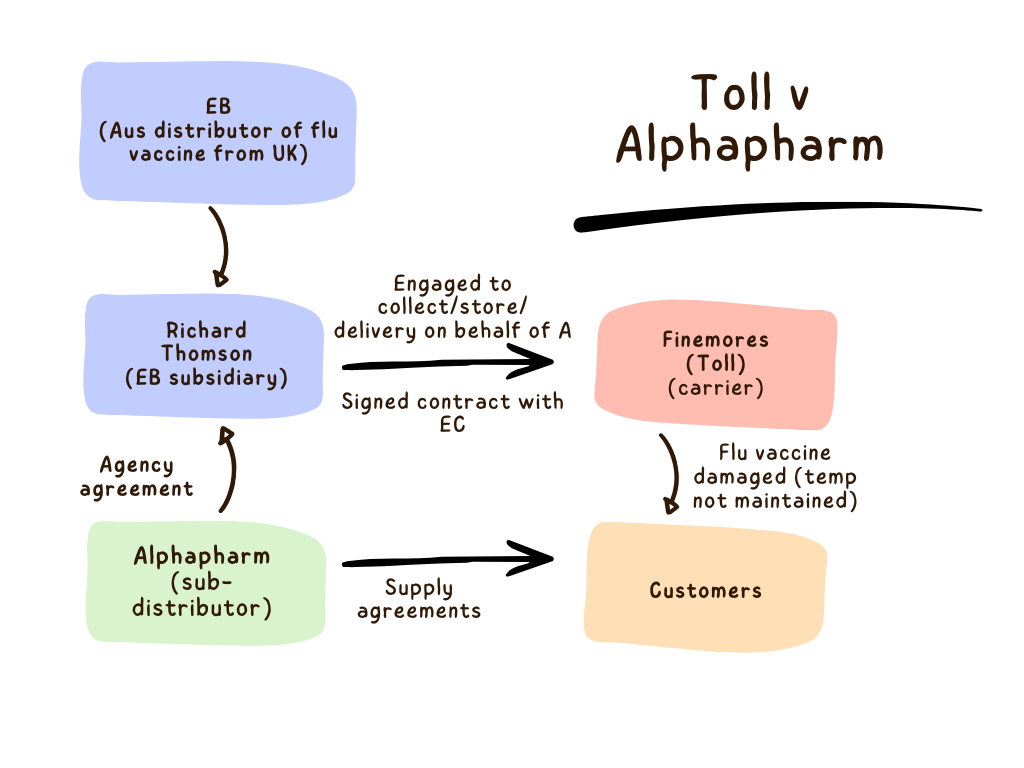
Ebos, through its Australian subsidiary, Richard Thomson Pty Ltd (RT) was a wholesaler of medical supplies. This case related to the supply of Fluvirin vaccines imported for the 1999 flu season. EB appointed Alphapharm its exclusive distributor of Fluvirin in Australia.
RT advised Alphapharm that it would engage Finemores (a carrier - later to become ‘Toll’) to collect the vaccines from the airport in Sydney and transport them to the warehouse and store them. It suggested that Alphapharm also use Finemores to reduce handling. Alphapharm agreed and agreed that RT should make the arrangements on Alphapharm’s behalf - including ‘to enter such arrangement as was necessary in that regard’ (p 171).
Alphapharm agreed that (for a fee) RT would look after storage, regulatory approval and distribution in Australia. RT suggested that Finemores (a carrier - later to become ‘Toll’) be engaged for this purpose and Alphapharm agreed - also agreeing that RT could act as its agent in dealing with Finemores for this purpose.
After RT contacted Finemores requesting a quote, Finemores provided a quote under a cover letter stating that cartage was subject to conditions on the reverse side of the attached consignment note (no such note was attached but nothing turned on this) and the letter further requested that upon acceptance RT complete a ‘credit application form’ and sign a rate schedule with conditions.
RT met with Finemores on 17 February and was presented with a ‘Credit application form’. It included a statement, just above the signature line, 'stating ‘Please read “Conditions of Contract” (Overleaf) prior to signing.” The RT representative did not read the conditions, but did sign the form.
The ‘Conditions of Contract’ included an exclusion clause, providing Finemores would not be liable for, among other things, loss or damage occurring while they stored or delivered the vaccines.
Two batches of vaccines were destroyed - one during transit between Finemore’s storage warehouse and another while at the warehouse. In both cases the vaccines fell below the required refrigeration levels and were rejected by the regulators.
Claims/arguments
Alphapharm sued Finemores for damages; Finemores relied on the exclusion clause.
A question arose about whether Alphapharm was bound by the exclusion clause; this involved consideration of whether they were party to the agreement (whether RT was effectively acting as agent) and whether the exclusion clause was effective.
Timeline

The trial judge
The trial judge found in favour of Alphapharm. In particular, Acting Judge Hogan found that the Conditions of Contract on the reverse side of the Application for Credit did not form part of the contract and also that RT had not contracted as agent for Alphapharm.
On appeal to Court of Appeal
The Court of Appeal unanimously rejected an appeal.
On appeal to High Court
The High Court unanimously upheld an appeal. RT was acting as agent for Alphapharm and the terms were properly incorporated into the contract; where a person signs a document knowing it contains contractual terms then, absent a vitiating element, they will be bound by the terms, whether or not they have read or understood them.
Key finding
The High Court accepted the general rule developed in L’Estrange v Graucob:
[para 57]: The general rule, which applies in the present case, is that where there is no suggested vitiating element, and no claim for equitable or statutory relief, a person who signs a document which is known by that person to contain contractual terms, and to affect legal relations, is bound by those terms, and it is immaterial that the person has not read the document.
Key extracts
[Emphasis added]
On the objective nature of the assessment
[after criticising attention given to irrelevant and inadmissible material relating to subjective understanding of individual participants [at 35]]
[36] In Codelfa Construction Pty Ltd v State Rail Authority of NSW [(1982) 149 CLR 337 at 352], Mason J observed:
‘‘We do not take into account the actual intentions of the parties and for the very good reason that an investigation of those matters would not only be time consuming but it would also be unrewarding as it would tend to give too much weight to these factors at the expense of the actual language of the written contract.’’
[40] This Court, in Pacific Carriers Ltd v BNP Paribas [(2004) 218 CLR 451 at 461-462 [22]], has recently reaffirmed the principle of objectivity by which the rights and liabilities of the parties to a contract are determined. It is not the subjective beliefs or understandings of the parties about their rights and liabilities that govern their contractual relations. What matters is what each party by words and conduct would have led a reasonable person in the position of the other party to believe. References to the common intention of the parties to a contract are to be understood as referring to what a reasonable person would understand by the language in which the parties have expressed their agreement. The meaning of the terms of a contractual document is to be determined by what a reasonable person would have understood them to mean. That, normally, requires consideration not only of the text, but also of the surrounding circumstances known to the parties, and the purpose and object of the transaction. [footnotes omitted]
On whether clause 6 was a term of the contract
[29] Each of the four parties to the case is a substantial commercial organisation, capable of looking after its own interests. This hardly seems an auspicious setting for an argument that a party who signs a contractual document is not bound by its terms because its representative did not read the document.
…
[General principles]
[38] The point at issue on this appeal concerns not the creation of legal relations by the nature of the legal relations created.
[39] Any suggestion that the agreement between Richard Thomson and Finemores was vitiated by misrepresentation would be untenable. Mr Gardiner-Garden signed a document which invited him to read the terms and conditions on the reverse before signing. He was not rushed or tricked into signing the document. He chose to sign it without reading it. He could have read it had he wished. Finemores did not set out to conceal from him the terms and conditions on the document, or to encourage him not to read them. Finemores had no way of knowing that he did not read the document. No case of mistake or non est factum is advanced.
…
[42] Consistent with this objective approach to the determination of the rights and liabilities of contracting parties is the significance which the law attaches to the signature (or execution) of a contractual document. In Parker v South Eastern Railway Co [(1877) 2 CPD 416 at 421], Mellish LJ drew a significant distinction as follows:
‘‘In an ordinary case, where an action is brought on a written agreement which is signed by the defendant, the agreement is proved by proving his signature, and, in the absence of fraud, it is wholly immaterial that he has not read the agreement and does not know its contents. The parties may, however, reduce their agreement into writing, so that the writing constitutes the sole evidence of the agreement, without signing it; but in that case there must be evidence independently of the agreement itself to prove that the defendant has assented to it.’’
[43] More recently, in words that are apposite to the present case, in Wilton v Farnworth [(1948) 76 CLR 646 at 649] Latham CJ said:
‘‘In the absence of fraud or some other of the special circumstances of the character mentioned, a man cannot escape the consequences of signing a document by saying, and proving, that he did not understand it. Unless he was prepared to take the chance of being bound by the terms of the document, whatever they might be, it was for him to protect himself by abstaining from signing the document until he understood it and was satisfied with it. Any weakening of these principles would make chaos of every-day business transactions.’’
[44] In Oceanic Sun Line Special Shipping Co Inc v Fay [(1988) 165 CLR 197 at 228], Brennan J said:
‘‘If a passenger signs and thereby binds himself to the terms of a contract of carriage containing a clause exempting the carrier from liability for loss arising out of the carriage, it is immaterial that the passenger did not trouble to discover the contents of the contract.’’
[45] It should not be overlooked that to sign a document known and intended to affect legal relations is an act which itself ordinarily conveys a representation to a reasonable reader of the document. The representation is that the person who signs either has read and approved the contents of the document or is willing to take the chance of being bound by those contents, as Latham CJ put it, whatever they might be. That representation is even stronger where the signature appears below a perfectly legible written request to read the document before signing it.
[46] The statements in the above authorities accord with the well-known principle stated by Scrutton LJ in L’Estrange v F Graucob Ltd [[1934] 2 KB 394 at 403] that ‘‘[w]hen a document containing contractual terms is signed, then, in the absence of fraud, or, I will add, misrepresentation, the party signing it is bound, and it is wholly immaterial whether he has read the document or not’’.
[Application here]
[49] To speak of the operation of the law of contract with respect to the signature of the document containing cl 6 requires attention both to the significance attached by the law to the presence of the signature and also to the absence of any grounds, such as a plea of non est factum, which at common law would render the contract void and of any grounds, such as misrepresentation, which might attract equitable relief, or which might elicit curial dispensation under a statutory regime. …
[50] An application of settled principle in the present case leads to the conclusion that the terms and conditions on the reverse of the Application for Credit formed part of the contract governing the storage and transportation of the goods.
[51] The reasoning of the primary judge, accepted by the Court of Appeal, was based upon the proposition that, in order for those terms and conditions to be made part of the contract, it was necessary for Finemores to establish that it had done what was reasonably sufficient to give Richard Thomson notice of the terms and conditions (the major premise), and the further proposition that Finemores had not done what was reasonably sufficient to give Richard Thomson such notice (the minor premise).
[52] It would be possible to dispose of the appeal by disagreeing with the minor premise. What more Finemores could have done to give Richard Thomson notice of the terms and conditions than requiring their representative to sign a document, and to place his signature immediately below a request that he read the conditions on the reverse side of the document before signing, is difficult to imagine. [In brief, if reasonable notice was required, it had been given]
[53] Of wider importance, however, is the major premise. If correct, it involves a serious qualification to the general principle concerning the effect of signing a contract without reading it. The proposition appears to be that a person who signs a contractual document without reading it is bound by its terms only if the other party has done what is reasonably sufficient to give notice of those terms. If the proposition is limited to some terms and not others, it is not easy to see what the discrimen might be.
[54] It appears from the reasoning of the primary judge and the Court of Appeal that the proposition was given a narrower focus, and was limited to exclusion clauses, or, perhaps, exclusion clauses which are regarded by a court as unusual and onerous. The present happens to be a case about exclusion clauses, but there is no apparent reason why the principle, if it exists, should apply only to them. Nor is the criterion by which a court might declare a contractual provision to be unusual or onerous always easy to identify. The origin of the proposition, clearly enough, is in the principles that apply to cases, such as ticket cases, in which one party has endeavoured to incorporate in a contract terms and conditions appearing in a notice or an unsigned document. When an attempt is made to introduce the concept of sufficient notice into the field of signed contracts, there is a danger of subverting fundamental principle based on sound legal policy. There are circumstances in which it is material to ask whether a person who has signed a document was given reasonable notice of what was in it. Cases where misrepresentation is alleged, or where mistake is claimed, provide examples. No one suggests that the fact that a document has been signed is for all purposes conclusive as to its legal effect. At the same time, where a person has signed a document, which is intended to affect legal relations, and there is no question of misrepresentation, duress, mistake, or any other vitiating element, the fact that the person has signed the document without reading it does not put the other party in the position of having to show that due notice was given of its terms. Furthermore, it may be asked, where would this leave a third party into whose hands the document might come?
[55] In L’Estrange v Graucob [[1934] 2 KB 394 at 402-403], Scrutton LJ said that the problem in that case was different from what he described as ‘‘the railway passenger and cloak-room ticket cases …’’, where ‘‘there is no signature to the contractual document, the document being simply handed by the one party to the other’’. His Lordship said:
‘In cases in which the contract is contained in a railway ticket or other unsigned document, it is necessary to prove that an alleged party was aware, or ought to have been aware, of its terms and conditions. These cases have no application when the document has been signed.’’
[56] In the same case Maugham LJ, who agreed with Scrutton LJ, referred to three possible circumstances in which the party who signed the document might not have been bound by its terms. The first was if the document signed was not a contract but merely a memorandum of a previous contract which did not include the relevant term. The second was a case of non est factum. The third was a case of misrepresentation. [fn omitted]
[57] If there is a claim of misrepresentation, or non est factum, or if there is an issue as to whether a document was intended to affect legal relations or whether, on the other hand, it was tendered as a mere memorandum of a pre-existing contract, or a receipt, or if there is a claim for equitable or statutory relief, then even in the case of a signed document it may be material to know whether a person who has signed it was given sufficient notice of its contents. The general rule, which applies in the present case, is that where there is no suggested vitiating element, and no claim for equitable or statutory relief, a person who signs a document which is known by that person to contain contractual terms, and to affect legal relations, is bound by those terms, and it is immaterial that the person has not read the document. L’Estrange v Graucob explicitly rejected an attempt to import the principles relating to ticket cases into the area of signed contracts. It was not argued, either in this Court or in the Court of Appeal, that L’Estrange v Graucob should not be followed.
…
[63] There may be cases where the circumstances in which a document is presented for signature, or the presence in it of unusual terms, could involve a misrepresentation. No such problem exists in the present case. There could also be circumstances in which one party would not reasonably understand another party’s signature to a document as a manifestation of intent to enter into legal relations, or of assent to its terms. Again, that is not this case. It was reasonable of Finemores to treat Mr Gardiner-Garden’s signature as a manifestation of assent to the conditions he had been invited to read before signing.
[64] … The evidence was against any conclusion that the conditions were abnormal. There was no evidence to support a finding that applications for credit in the transport industry do not normally contain general terms of contract. … More fundamentally, the concern felt by the Court of Appeal was not addressed under the rubric of misrepresentation. Any suggestion of misrepresentation had been dismissed by the primary judge, and had no basis in fact. Mr Gardiner-Garden was not subjected to any pressure, and there was no element of concealment. There was no evidence that he was induced to sign the document by anything other than the request that he sign it. If the case had been one of misrepresentation, then it would have fallen within the qualification expressed in L’Estrange v Graucob; but it was not.
…
On whether RT was contracting as agent for Alphapharm
[70] In contracting to obtain the supply of those services, Richard Thomson was acting for the benefit of Alphapharm. …
[71] It was Richard Thomson that agreed with Finemores upon the rates to be charged for Finemores’ services, but it was Ebos and Alphapharm that received the benefit, and bore the cost, of those services. It was Richard Thomson that gave Finemores the necessary information and instructions relating to delivery of the goods to Alphapharm’s customers, but it did this in response to instructions it received from Alphapharm. All this happened in consequence of the conversation between Mr McGee and Mr van der Pluijm of 15 February 1999 in which the latter accepted the former’s recommendation that Alphapharm ‘‘use Finemores for carriage from the warehouse to the purchasers, to reduce handling’’. All relevant use by Alphapharm of the services of Finemores occurred through Richard Thomson as an intermediary. Subject only to Mr van der Pluijm’s attendances at the warehouse to label the goods, and thereby appropriate them to Alphapharm, it was through Richard Thomson that Alphapharm dealt with Finemores. Mr van der Pluijm, in cross-examination, acknowledged the obvious fact that Alphapharm left it to Richard Thomson to arrange for the storage of the goods and their delivery to Alphapharm’s customers.
[72] Finemores was not privy to the sub-distribution agreement between Ebos and Alphapharm. It was not aware, and could not reasonably have been expected to be aware, of the contractual provisions governing risk and title. The commercial purpose of cl 5 of the Conditions of Contract, and the provisions concerning the ‘‘Customer’s Associates’’, is clear. It was to cover exactly the kind of situation that existed in the present case. Such a situation is common. Finemores required its account customer to agree to detailed conditions about liability for damage to the goods. Its conditions were expressed to bind all who had an interest in the goods, and it required the customer to warrant that it had authority to act as their agent as well as on its own behalf.
[73] … There was no suggestion of any limitation being imposed by Alphapharm as to the terms and conditions to which Richard Thomson might agree. When, later, Mr van der Pluijm saw the terms and conditions he had no problem with them, and subsequently he accepted the same terms and conditions when Alphapharm dealt directly with Finemores.
…
[80] The evidence made it plain that Alphapharm required services of the kind provided by Finemores, that it decided to use the services of Finemores, that it designated Finemores’ warehouse as its store for the purpose of the sub-distribution agreement, that it appropriated the goods while they were in Finemores’ store, and that it required Finemores to transport the goods to Alphapharm’s customers. It is also clear that Alphapharm left it to Richard Thomson to arrange the necessary contract pursuant to which Finemores was to provide those services for the benefit of Alphapharm. The terms on which Richard Thomson contracted were Finemores’ standard terms and conditions.
[81] The primary judge’s conclusion that the relationship of agency ‘‘was a limited one whereby Richard Thomson made the administrative arrangements on behalf of Alphapharm for the timing and size and identification of the outbound shipments’’ appears to overlook the most obvious feature of the commercial circumstances, which was that the outbound shipments were to take place pursuant to a contract, and that, at the very least, the rates of freight and terms of payment had to be agreed. It is not enough to say that Richard Thomson was to pass the cost on to Alphapharm. Someone had to agree about the cost, which was to be borne by Alphapharm. The evidence compels the conclusion that Alphapharm authorised Richard Thomson to contract with Finemores and to agree upon rates of freight, terms of payment, and such other standard terms and conditions of the contract of storage and transportation as were required by Finemores. So long as the terms and conditions to which Richard Thomson agreed were Finemores’ standard terms and conditions then Richard Thomson was acting within its authority.
…