Saleh v Romanous
Supreme Court of New South Wales, Court of Appeal
[2010] NSWCA 274; (2010) 79 NSWLR 453


Case details
Court
Supreme Court (NSW)
Court of Appeal
Citation
Saleh v Romanous
[2010] NSWCA 274 ➤
(2010) 79 NSWLR 453
Date
28 October 2010
Judges
Giles JA
Handley AJA
Sackville AJA
Outcome
Appeal dismissed
Appeal from
Forster J
Citation
Romanous v Saleh
[2009] NSWSC 1166 ➤
Issues
Promissory Estoppel
Parol Evidence Rule
Overview
Facts
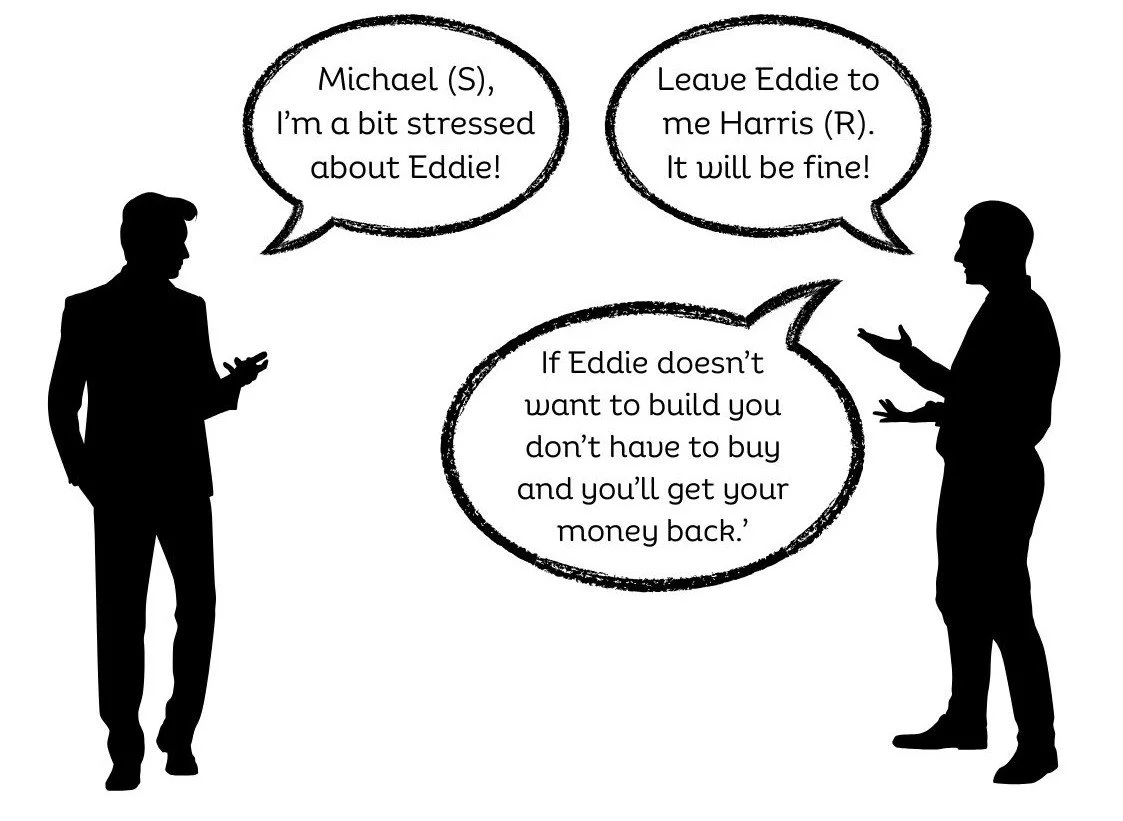
The vendors (inc Michael Saleh) and Saleh’s brother, Edmond, owned adjoining properties at 163 and 165 Kissing Point Road, respectively. They obtained development approval for eight townhouses on the combined site. Saleh entered into an agreement with the purchasers (inc Harris Romanous) to purchase the property at 163. This was done on the understanding that Edmond would work with the purchasers on the development. This understanding was encouraged by Saleh who, in response to queries from Romanous, told him not to worry about ‘Eddie’ and that if Eddie didn’t want to build they didn’t have to buy and and could get their money back.
When (years later) Saleh subsequently sought to rescind the contract a question arose about whether there was a pre-contractual promissory estoppel preventing Saleh relying on the entire agreement clause in the contract and enforcing the contract.
Trial
At trial, Justice Forster found there was a pre-contractual promissory estoppel and ordered the vendors to repay the deposit and a loan and pay for certain building work.
Appeal
The vendors claimed the parol evidence rule and the contract (containing an entire agreement clause) excluded pre-contractual promissory estoppel.
The court disagreed and the appeal was dismissed. Importantly, the Court noted that promissory estoppel did not involve enforcement of the contract. It 'could not give the purchasers positive rights: ‘… A promissory estoppel is a restraint on the enforcement of rights, and thus, unlike a proprietary estoppel, it must be negative in substance. …’ [compare Waltons Stores]

Facts
The appellant/vendors (Michael Saleh and his wife, Rose) owned land at 163 Kissing Point Road, Dundas. Saleh’s brother, Edmond, owned the neighbouring property at 165 Kissing Point Road, Dundas. They obtained development approval for eight two storey townhouses on the combined site in July 2003.
The respondents/purchasers were Harris Romanous (a plumber and builder) and his wife, Philomena.
The vendors then entered into a contract to sell #163 to the respondents in May 2004. The contract included an ‘entire agreement’ clause. The price was negotiated on the basis that the two properties would be developed together. The vendors had provided the purchasers with a statutory declaration stating that Edmond had appointed him “as his agent for negotiating” with the purchasers concerning the development and that all communications were to be made to Michael Saleh.
It was established at trial that prior to the sale, Michael Saleh had said to Harris Romanous “Leave Eddie up to me. I’m taking responsibility for Eddie. If Eddie doesn’t want to build you don’t have to buy and you’ll get your money back. to believe that Edmond would participate in the development joint venture and entered into the contract on that basis.” [p 455]. Saleh confirmed this promise a few days later.
After the contractual date for completion (24 June 2004) passed without completion, the purchasers prepared an agreement with Edmond for joint development that was sent to Saleh and apparently signed by Edmond; the trial judge found that this was forged “almost certainly by Michael Saleh”.
Following several meetings, in late August the purchasers sought to rescind the contract and were advised (in September) the vendors would not agree to the rescission.
In January 2005 Michael Saleh arranged for demolition of the house with Harris’ consent. Throughout 2005 the “vendors did not attempt to enforce the contract and the purchasers did not attempt to rescind.” [para 17]
In March 2006 the purchasers’ solicitors sent a letter of demand claiming the deposit, loan and building debt. The vendors responded asserting a right to forfeit the deposit. The purchasers responded purporting to rescind and later (August 2006) commenced action to recover the deposit, loan and building debt.
[These facts were summarised from the judgment of Justice Handley]
Giles JA
Agreed with Justice Handley
Handley JA
After setting out the facts his Honour first considered the appellant’s argument that the findings regarding any pre-contractual promise were “glaringly improbably” [para 24] and concluded [at 50]:
‘In my judgment the vendors have not established that the finding that Michael made the pre-contractual promise was glaringly improbable, or contrary to incontrovertible facts.’
Handley JA then turned to the estoppel claim and held that the parol evidence rule did not prevent a promissory estoppel claim; importantly, promissory estoppel did not involve enforcement of the contract, but an equitable restraint on the exercise or enforcement of rights:
[55] … Like other doctrines developed by the Court of Chancery [promissory estoppel] imposes equitable restraints on the enforcement of contractual and other rights. The leading promissory estoppel cases before 1973 were based on post-contractual conduct where the parol evidence and entire contract rules did not apply.
[56] There are other equitable restraints on the enforcement of contractual rights based on pre-contractual conduct. They include the equitable remedies for common law and equitable fraud, for innocent misrepresentation and mistake, and some restraints on the enforcement of common law rights by injunction or specific performance …
[57] These remedies and defences trump the legal rules about parol evidence and entire contracts.
[58] Mr Rayment relied on Hoyt’s Pty Ltd v Spencer (1919) 27 CLR 133 as authority for the proposition that an informal collateral contract, in consideration for entering into the principal contract, cannot be inconsistent with it. … The Judge held, correctly, that a collateral contract based on the pre-contractual promise would be inconsistent with the contract of sale. …
[61] Mr Rayment submitted that the collateral contract in Hoyt’s case, like the promissory estoppel in the present case, was an attempt to restrict the exercise of rights under a written contract. He said that a collateral promise which could not be enforced as a contract could not be enforced as a promissory estoppel.
[62] I reject these submissions. A promissory estoppel is not enforced as a contract, but as an equitable restraint on the exercise or enforcement of the promisor’s rights. Hoyt’s case did not decide that the sub-lessee had no equity …
[63] … Enforcement of a pre-contractual promissory estoppel is not barred by Hoyt’s case.
…
[68] [After discussing several cases dealing with collateral contracts and promissory estoppel]: In all these cases the legal rights trumped by equity include those protected by the parol evidence and entire contract rules.
…
[73] In my judgment the Judge correctly held that the purchasers had established a promissory estoppel which entitled them to restrain the vendors from enforcing the contract of sale. Such an estoppel is not the equitable equivalent of a contract, and cannot give the purchasers positive rights to rescind and recover their deposit that they would have had if the pre-contractual promise had contractual force. A pre-contractual promissory estoppel which conferred positive rights of that nature would be contrary to Hoyt’s case.
[74] A promissory estoppel is a restraint on the enforcement of rights, and thus, unlike a proprietary estoppel, it must be negative in substance. …
…
[81] The Judge held that the promissory estoppel entitled the purchasers to rescind and recover their deposit. In my judgment positive relief was not available on that ground but his decision that the promissory estoppel prevented the vendors enforcing the contract entitled the purchasers to an order under s 55(2A) [of the Conveyancing Act].
…
[83] The claim based on an oral collateral contract was rightly rejected in accordance with Hoyt’s case. The claims in fraud as pleaded failed on the facts, and other possible claims in fraud were not pleaded. …
Sackville AJA
Agreed with Handley AJA