Oceanic Sun Line v Fay
Oceanic Sun Line Special Shipping Company Inc v Fay
[1988] HCA 32 (30 June 1988) (High Court of Australia)

Case details
Court
High Court of Australia
Citations
Oceanic Sun Line Special Shipping Company Inc v Fay
[1988] HCA 32 ➤
(1988) 165 CLR 197
(1988) 62 ALJR 389
(1988) 79 ALR 9
Judges
Wilson J
Brennan J
Deane J
Toohey J
Gaudron J
Appeal from
NSW Court of Appeal
Judges
Kirby P (dissenting)
Glass JA
McHugh JA
Citation
Oceanic Sun Line Special Shipping Co Inc v Fay
(1987) 8 NSWLR 242
(1987) ASC 55-568
Date
31 March 1987
Trial
Supreme Court of NSW
Trial Judge
Justice Yeldham
Order date
9 September 1986
Issues
Incorporation of Terms
Private international law
Overview
Facts
Dr Fay and his wife were passengers on the Greek vessel, MS Stella Oceanis. When cruising between Samos and Ikaria a shot gun exploded during shipboard trapshooting entertainment and Dr Fay was severely injured (spending three weeks in a hospital in Athens before returning to Sydney where he had several major operations). He commenced proceedings in NSW against Oceanic (Greek corporation and owner of Stella Oceanis) alleging negligence.
One issue was where the contract was concluded. Dr Fay had engaged a travel agency (Mary Rossi Travel) in Sydney to arrange the trip. Mary Rossi Travel provided them with a brochure relating to the cruise and subsequently Mary Rossi Travel made a booking on behalf to the Fays. Upon payment JMA Tours (an office of Sun Line) issued a document labeled an ‘Exchange Order’ in the names of Dr and Mrs Fay. The exchange order included a clause relating to cancellation or alteration of itinerary.
When in Greece, Mary Rossi (who was leading the group tour) exchanged the various Exchange Orders for tickets at the Sun Line office in Athens. This was essentially a booklet of ‘coupons’ provided upon boarding. On the front cover of the ticket were the words ‘Passage Ticket and Contract’ and the following notice.
"Each passenger should carefully examine this ticket, particularly the Conditions printed on pages 1,2,3 and 4 of its inside covers especially as regards limitation of liability, adjustment of fare rates etc."
Each coupon contained the printed notice:
"The Conditions printed on pages 1,2,3 and 4 of the cover of this ticket form part of this contract."
Relevantly, clauses 12 and 13 respectively, included exemptions as to liability and a jurisdiction clause, specifying that any action mut be brought before the courts of Athens, to the exclusion of other courts. The Fays never saw these clauses.
Had they read the brochure closely before booking, they may have seen a declaration that the cruise was "governed by the terms and conditions printed on the Passenger Ticket Contract which may be inspected at any Sun Line office", with JMS Tours in Sydney being one such office. They did not read the brochure and, if they had, no copy of the ticket was actually available at JMA Tours.
One question was whether the exclusive jurisdiction clause formed part of the contract.
Note: the key question in the case related to private international law and the appropriate forum for litigation; a key factor in making this determination was where the contract of carraige was concluded.
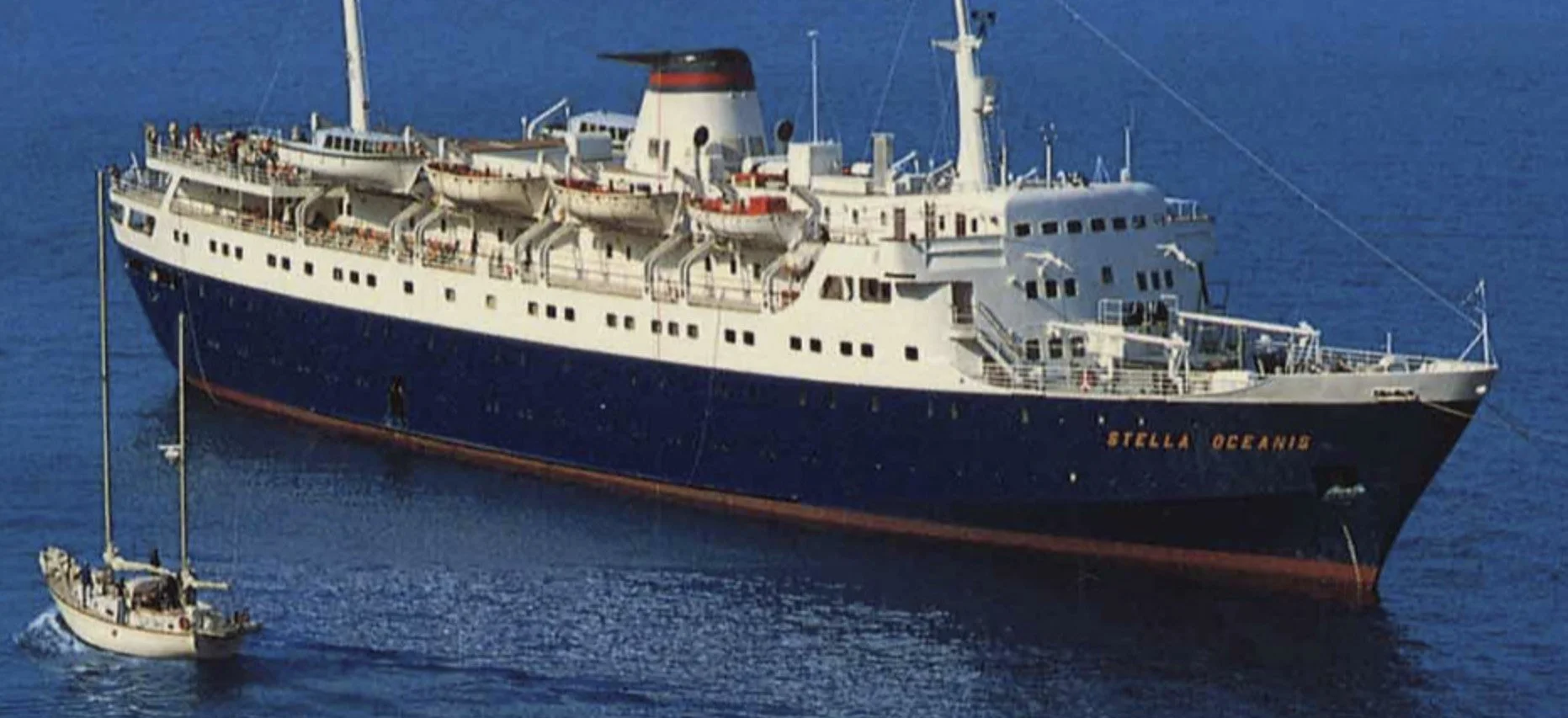
Image of MV Stella Oceanis from midshipcentury.com
Supreme Court (Trial)
Justice Yeldham
Justice Yeldham concluded that the contract of carriage was completed in Sydney and that the ticket (with the relevant exclusion and jurisdiction clauses) did not form part of that contract.
Court of Appeal (NSW)
Justice McHugh (with whom Justice Glass agreed), upheld the finding of Justice Yeldham that the contract of carriage was made in NSW.
Justice Kirby dissented. His Honour considered himself bound by the decision of the High Court in MacRobertson which he did not consider sufficiently distinguishable from the facts here.
In the course of his judgment his Honour usefully set out the factual background that led to this litigation:
[Page 244] “What began as an idyllic cruise in the Aegean sea finished for the respondent in a serious and incapacitating injury and in this litigation. The injury occurred in Greek waters soon after the appellant's vessel MS “Stella Oceanis”, upon which the respondent was travelling as a passenger, left Kusadasi, Turkey. The respondent was injured when a shot gun, being used in an entertainment of trap shooting, discharged. The respondent, who is a veterinary surgeon resident in Queensland, claims damages for his injuries and disabilities which he attributes to the negligence of the appellant. That company has no place of business anywhere in Australia. It was served with the process of this Court in Athens, Greece, its principal place of business. It has entered a conditional appearance to protest the jurisdiction of this Court to hear the proceedings.”
In considering the issue of contractual formation his Honour stated:
[Page 251] [After referring to MacRobertson Miller Airline Services v Commissioner of State Taxation (Western Australia) (1975) 133 CLR 125 where the Court determined that an airline ticket issued in that case was merely an offer to carry the passenger, which was'] “accepted by the passenger’s subsequent conduct in boarding the plane and travelling on the journey.
… analysis of the contractual arrangements is obviously important for the present case, because of the similarity of the arrangements being characterised for legal purposes. The attempt to distinguish, for the application of legal principles, air transport from other forms of transport, is quite unconvincing. Passenger travel by plane and, to a lesser extent, rail, road and sea transport, moves millions of people throughout the world every day. Mishaps occur, for which liability must be assigned. Journeys normally take place pursuant to tickets issued to passengers. Carriers typically endeavour to limit their liability. Every passenger, particularly on an airline, knows that nowadays fine print conditions are attached to the ticket by which the carrier attempts to exclude or limit its liability. Few normal passengers bother to read such conditions. A lawyer in an idle moment might do so. …”
[Page 252] “It is preferable, in endeavouring to assign the proper legal character to the dealings between the parties, to take into account all of the relevant documentation available to them, including the brochure with its list of “Things to Know Before You Go” and the exchange order. The mere fact that a passenger does not actually read relevant terms of such documents cannot, of itself, release the passenger from the consequences, if any, of terms and conditions lawfully incorporated in the arrangements between the carrier and the passenger. This is so, as long as the carrier has taken reasonable steps to call its terms and conditions to the attention of the passenger. Otherwise, by a refusal or neglect to read clear terms, clearly presented, the passenger could insulate himself from the operation of their provisions.
In the present case, I believe the carrier did take all reasonable steps to signify the fact and terms of its conditions of carriage …
First, in the brochure which the intending passengers received (and which the respondent admits to having looked at), there are numerous statements in the second last page, indicating clearly that there is a “passage contract”. It clearly contains general conditions. The conveyance of the passenger is subject to them. By accepting the contract with the appellant, the passenger must be taken to have agreed to them.
Secondly, the exchange order contains a number of indications that it is not the ticket and not the passage contract necessary to provide an G enforceable right of carriage. It is simply, as its name indicates, an order to be “exchanged” for that ticket. The indicia to this effect are contained both in the title of the document and in three items in the warning attached. It refers to an “Article 2” of the “Passage Contract”. These words put the passenger on notice that the existence of such a contract and of the fact that there are at least two articles to it. As well, the wide powers reserved to the carrier in [253] respect of cancellation or change of itinerary and departure are put on notice. But most importantly, it is clearly indicated that the “order” will be exchanged for a “ticket”, when boarding the vessel.
… the exchange order clearly notifies the passenger of the existence of another document. It specifically indicates that the exchange order is not the ticket. Tickets are normally the precondition to travel on passenger conveyances, including by sea. This much was acknowledged by the respondent in his evidence. Therefore, the voucher, far from being a ticket which could be enforced as a concluded contract for carriage, denies that statement by the indication that, at a later stage, a ticket will need to be secured. And by inference, that ticket will contain articles of a passage contract, of which the passenger is put on notice.
…
This, then, would seem to be a case covered by the analyses offered by the High Court in MacRobertson. It may be argued that this conclusion produces an unjust result. It may be suggested that it derives from legal reasoning developed in earlier and more leisurely transactions, inappropriate to the conditions of modern international travel by air, rail or sea: … It may be urged that a more just and appropriate [254] approach would be one to fix the carrier with liability (being usually better able to bear the loss and to pass it on) unless the carrier can clearly establish that it has brought its limiting terms and conditions to the actual notice of the passenger. … If I were approaching the resolution of this issue, uncontrolled by authority binding on me, I would consider it to be ripe for fresh analysis, more apt for the actual conditions of the vast growth in modern international travel. But I am bound by the analyses in MacRobertson.
High Court
All members of the Court concluded that the contract of carriage had been concluded in NSW and that the conditions on the ticket did not form part of the contract.
[Emphasis added throughout]
Wilson and Toohey JJ
The contract was concluded in Sydney.
[11] …. If a contract of carriage was not concluded before the respondent left Australia then it must follow that, notwithstanding that the entire passage money had been paid and that a particular cabin on a particular vessel had been allocated to him for a specified cruise and that although nothing remained for him to do except to present himself in Athens with the exchange order, the appellant came under no obligation to carry him until he did so. Such a construction of the circumstances flies in the face of common sense and cannot be accepted. When he left Australia the respondent had a contractual right to receive from the appellant on presentation of the exchange order in Athens a passage ticket which enabled him to board the vessel and occupy the specified cabin for the duration of the cruise subject only to such conditions as are found to form part of the contract.
[16] Once it is accepted that there was a contract of carriage concluded between the parties in Sydney, there are formidable obstacles in the path of the appellant's argument that the conditions on the ticket and in particular the submission to Greek jurisdiction formed part of that contract. Yeldham J. was surely right in his view "that the brochure was not contractual in nature and did not enter into or form any part of the relevant contract of carriage". Essentially it was a document designed to interest would-be travellers in the appellant's cruises to various parts of the Mediterranean. It contained much that was of historical and geographical interest as well as displaying the facilities that were available to those participating in the cruises. It was advertising material, available to any one. Its reference under "Things To Know Before You Go" to the transportation of passengers being governed by the terms and conditions printed on the passenger ticket contract was informative but not contractual … And it was expressed in the context that the ticket contract "may be inspected at any Sun Line office". Such a statement was not particularly helpful if, as may have been the case, there was no Sun Line office in Australia.
[17] Yeldham J. also concluded that the ticket "did not form any part of the contract" between the parties. And in that conclusion he was right. The ticket was issued after the contract was concluded. As just mentioned, the brochure was informative but not contractual; hence the appellant cannot rely upon it as a means of incorporating the terms and conditions on the ticket into the contract. The exchange order was part of the contract but it did not purport to incorporate the ticket. It is true that it made mention of "Article 2 of the Sun Line passage contract" but that was to make it clear that cancellation of passage was likely to involve forfeiture of the passage money. Nothing said on the exchange order operated to include, as part of the contract, terms and conditions on a ticket not provided to the respondent until after he had paid his fare in Sydney and had arrived in Greece to begin his Sun Line cruise. …
Brennan J
The contract of carriage was entered into in Sydney; it could not subsequently be altered by the issuing of tickets in Athens.
Justice Brennan referred to the judgment of Stephen J in MacRobertson Miller Airline Services v Commissioner of State Taxation (Western Australia) (1975) 133 CLR 125, where is honour said (at p 137:)
"The conventional analysis of the formation of contracts for the carriage of passengers in those somewhat more leisurely transactions which involve the issue of a ticket in return for payment of a fare and the subsequent performance of the contract by the act of transportation, is to regard the ticket as the offer, the contract being made upon acceptance of that offer by the passenger".
But, Justice Brennan concluded:
[13] “… the conventional analysis cannot be applied to a ticket which the defendant is obliged to issue in exchange for an Exchange Order when a passenger is boarding a vessel. It can hardly have been the parties' intention at the time when the passenger pays his fare that the ticket to be given him on boarding should be a mere offer of carriage. Much less could it have been their intention that the offer might contain exemption clauses which were unknown to the passenger when the original contract was made. The arrangements contemplated at the time of the issue of the Exchange Order for exchanging that document for a ticket cannot reasonably support the hypothesis that when issued the ticket might be a mere offer containing exemption clauses which should bind the plaintiff only upon subsequent acceptance. Apart from the insufficiency of opportunity for the passenger who is boarding a vessel to read the conditions printed on the ticket and to elect whether to accept them, the election could be made only after travelling to Greece and obtaining the ticket, and the terms of the Exchange Order would require a passenger who then elected to decline the offer to forfeit the fare already paid. The better analysis of the transaction is that the defendant was bound to issue a ticket in exchange for the Exchange Order in performance of a contract of carriage already made, but the defendant was given no right to introduce new conditions of carriage by printing them on the ticket. The payment of the fare may rightly be regarded as the price of an option to acquire a ticket, but the option was not to acquire a mere piece of paper. It was an option to acquire a voucher or certificate of entitlement to be carried on terms already agreed - not on terms which the parties had yet to agree on.
[14] It was too late after the original contract was made to add conditions which were not incorporated in it. …
[15] If a passenger signs and thereby binds himself to the terms of a contract of carriage containing a clause exempting the carrier from liability for loss arising out of the carriage, it is immaterial that the passenger did not trouble to discover the contents of the contract. But where an exemption clause is contained in a ticket or other document intended by the carrier to contain the terms of carriage, yet the other party is not in fact aware when the contract is made that an exemption clause is intended to be a term of the contract, the carrier cannot rely on that clause unless, at the time of the contract, the carrier had done all that was reasonably necessary to bring the exemption clause to the passenger's notice … In the present case, the only step which the defendant took to bring the exclusive foreign jurisdiction clause to the plaintiff's notice before the fare was paid was the note in the brochure that the conditions of carriage were printed in the (unavailable) Passenger Ticket Contract. In Hollingworth v. Southern Ferries Ltd. (The "Eagle") (1977) 2 Lloyd's Rep 70, it was held that a mere statement in a carrier's brochure that the carrier contracted on its conditions of carriage was not enough to make those conditions terms of a contract of carriage subsequently made with an intending passenger who had read the brochure. …”
Deane J
[The contract was concluded in NSW (in this respect was in general agreement with Wilson and Toohey JJ)]
Gaudron J
“I respectfully adopt [Justice Brennan’s] statement of applicable principle and his Honour's conclusion that the foreign jurisdiction clause was not incorporated in the contract of carriage between the appellant and the respondent.”